
Sep 30, 2026
What Is Centella Asiatica Extract?
Centella asiatica extract powder is a standardized botanical active obtained from the complete aerial portions of Centella asiatica (L.) Urban, a perennial herbaceous wetland plant endemic to Asia. In professional B2B formulation settings, the term “centella asiatica extract powder” refers particularly to a pure concentration of four pentacyclic triterpenoids, with total triterpene assay grades of 10% to 80% (HPLC-verified): Asiaticoside, Madecassoside, Asiatic Acid, and Madecassic Acid. These actives promote quantifiable collagen production, anti-inflammatory response, wound re-epithelialization, and antioxidant activity, making this ingredient a proven option for skincare, oral beauty, and wound care formulations alike.
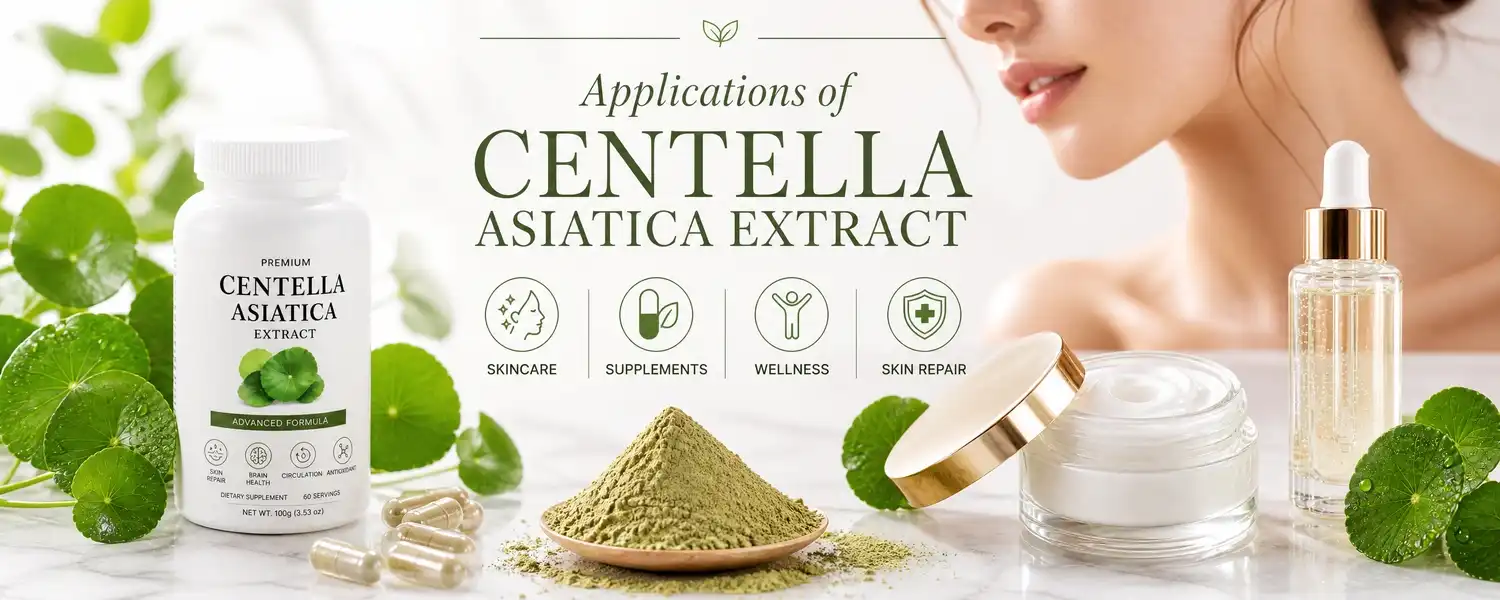
Understanding Centella Asiatica Extract: Definition and Core Benefits
What Makes the Active Profile Unique
So what are these four primary triterpenoids in this extract each doing? Asiaticoside and Madecassoside are glycosides that assist the body in repair and reduce the indications of inflammation. Asiatic acid and madecassic acid (aglycones) directly enhance TGF-β signals in skin fibroblasts, accelerating the synthesis of type I and type III collagen. This dual-pathway action is what makes Centella Asiatica distinct from plants that just have one mechanism.
Biological Mechanisms That Matter to Formulators
According to research published earlier, triterpenoids of Centella asiatica extract powder inhibit activation of pro-inflammatory cytokines such as IL-1β and TNF-α via NF-κB, and also restore integrity of the extracellular matrix. This implies that for ODM procurement teams, the constituent may cover both a functional anti-inflammatory claim and a structural skin-repair claim in a single INCI entry, which is a huge gain for formulation efficiency.
Applications Across Two Product Channels
The extract works for two commercial products and has the same level of science behind it. Applied topically, such as in repair serums, acne-calming creams, and post-surgery healing solutions, it corrects barrier function abnormalities and tiny patches of irritation. Oral beauty vitamins and nutraceuticals: Water-soluble, glycoside-dominant grades aid the body in the production of collagen and maintain skin flexibility from the inside out.
Choosing the Right Centella Asiatica Extract: Types, Forms, and Quality Considerations
Powder Grades and Solubility Formats
Choosing the right grade is the most important choice in creation. Standard grades have between 10% and 40% total triterpenes, look like brown powders with some polyphenols still in them, and can dissolve in alcohol. TECA grades that are more than 95% pure are white, crystalline powders that can dissolve in water if they are made properly. For serums that are mostly water, a Madecassoside-dominant grade is best because the glycoside fraction dissolves easily in water.
Here is a useful guide for choosing grades:
- 10%–20% extract: Cost-efficient for mass-market moisturizers and body lotions where a mild soothing claim is sufficient. Note that the brown color may affect finished product aesthetics in clear or white emulsions.
- 40%–60% extract: Targeted for premium repair serums and medical-grade topical products requiring a documented anti-inflammatory dosage.
- ≥80%–95% TECA grade: Reserved for pharmaceutical wound care applications and high-end dermocosmetics where clinical dosing precision and color neutrality are both required.
By matching the grade to the recipe, you can avoid having to redo the whole process, which saves your active ingredient claims.
Cosmetic-Grade vs. Oral-Grade Specifications
When it comes to cosmetics, important quality gates include microbe limits set by ISO 17516, heavy metal compliance set by EU Regulation EC 1223/2009, and pesticide residue levels that are in line with European pharmacopeial standards. For uses in oral beauty and dietary supplements, the extra rules include limits on solvent residues according to USP/EP, no benzo[a]pyrene, and food-grade certification (Kosher, Halal, or FSSC 22000). Compliance problems late in the project timeline can be avoided by checking with the seller to see what standard level they produce to before sampling.
What Supplier Documentation Should Include
Full paperwork is an important quality signal in B2B ingredient buying that can't be skipped. Before you agree to work with a seller, the document package should include:
- Certificate of Analysis (COA) with HPLC-confirmed triterpene assay per batch
- Material Safety Data Sheet (SDS/MSDS)
- Agricultural residue and heavy metal test reports from accredited third-party labs (SGS, Eurofins, or equivalent)
- FDA registration certificate and ISO 9001 / HACCP / FSSC 22000 certification copies
—An FDA registration certificate and copies of ISO 9001, HACCP, and FSSC 22000 certifications
Scientific Insights: Efficacy, Dosage, and Safety Profile
Clinically Referenced Dosage Ranges
0.1% to 0.5% of a standardized extract is the right amount in finished products to soothe and treat the skin on the surface. For reports of re-epithelialization and scar reduction, peer-reviewed wound care studies use 1.0% of a ≥95% TECA grade as the successful standard. Oral beauty dose studies usually use 30 to 60 mg/day of pure triterpenoid extract to see measurable results in skin firmness.
Safety and Stability Parameters
Triterpenoids from Centella asiatica extract are well-tolerated at the doses that are recommended. In clinical patch tests, they showed sensitization rates that were about the same as those of other botanical actives. The extract is stable up to about 50°C, which means it can be used with normal emulsion processing temperatures. Formulation pH should be between 4.5 and 6.5. Long-term UV exposure lowers effectiveness, so finished products with this ingredient should be packed in opaque or airtight containers to keep their effectiveness over time.
Synergistic Ingredient Pairings
Because the triterpene molecules are known to be acid-stable, Centella Asiatica extract makes sense to use with L-Ascorbic Acid (Vitamin C) products. The extract stops the barrier discomfort that comes with low-pH vitamin C serums, and both actives work together to help the extracellular matrix rebuild. In published in vitro studies, peptide combinations (Matrixyl, Argireline series) also show that they can add to collagen stimulation.
Procurement Guide: Where and How to Buy Centella Asiatica Extract Powder in Bulk
Key Supplier Qualification Criteria
When selecting a few bulk ingredient suppliers, you’ll want to be able to check three things: consistency of the active ingredient across production batches; the suppliers’ regulatory certification coverage (FDA registration, EU-compliant pesticide residue thresholds and food-grade certifications for oral applications); and the suppliers’ documented supply capacity. The feasible size of a steady ODM program supply is shown by a supplier with three facilities and an annual manufacturing capacity of more than 5,000 tons.
Sampling and Lead Time Expectations
The usual B2B qualifying procedure from inquiry to small-batch trial production takes roughly 6-12 weeks. Suppliers are expected to provide free samples within seven business days and return technical documents within twelve business hours. This fast turnaround halves your formulation validation time and reduces the total risk of the project.
Logistics and Compliance Considerations
International B2B purchasers should ensure that their supplier is using accredited freight forwarders and major express carriers such as DHL, FedEx, and UPS for sample shipments. If you are placing big orders, then knowing the supplier’s experience with export customs clearance, particularly with import laws for the EU and the US, can reduce the chances of late delivery in large ODM manufacturing runs.
Market Comparison: Centella Asiatica Extract Powder vs. Other Popular Ingredients
Centella Asiatica vs. Aloe Vera
Aloe vera moisturizes the skin surface dependably by creating a polysaccharide layer with moderate cooling effects. Centella asiatica extract powder acts at a deeper biological level rather than just prepping the surface of the skin to stimulate collagen formation, by upregulating collagen genes and downregulating inflammatory cytokines. However, for businesses looking to promote themselves as hospital-grade repair, Centella Asiatica has a more compelling narrative about how effectively it performs.
Centella Asiatica vs. Hyaluronic Acid
Hyaluronic Acid is the industry standard for temporary hydrating and plumping properties. It does not impact the production of collagen or the inflammatory pathways that induce inflammation. Centella Asiatica acts on the skin structure below, not the quantity of water on top. The two active ingredients tend to be combined in high-end products since they target separate biological targets and do not conflict or function well together.
Cost-Benefit Positioning for ODM Portfolios
For ODM firms with numerous SKU skin care lines, Centella Asiatica extract powder supports three separate product claim pillars: repair, calming, and anti-aging. It may be done with a single ingredient purchase. This reduces the number of SKUs for raw materials while still providing unambiguous claim differences throughout the product range. This saves money on formulation design.
Conclusion
Very few single botanical substances may claim the advantages of Centella asiatica extract for topical and oral usage. It increases collagen synthesis, lowers inflammation, and heals barriers like few other substances can. Buyers and R&D teams need to identify the proper purity grade, check batch-to-batch consistency via third-party documentation, and collaborate with a seller that has production capacity and certification coverage in line with their target markets. Getting these fundamental things right regarding sourcing Centella asiatica extract power helps safeguard your formulation claims and your supply chain against changes in quality.

FAQ
1. Why does Centella Asiatica extract precipitate in water-based serums?
Standard high-aglycone grades are lipophilic and resist dissolution in water phases directly. For aqueous serums, specify a Madecassoside-dominant grade, or pre-disperse the extract in a glycol carrier before incorporating it into the water phase. This simple process adjustment resolves compatibility issues before pilot production.
2. What is the functional difference between raw Gotu Kola powder and standardized extract?
Raw Gotu Kola powder is dried, ground plant material containing trace, variable active content below 1%. Standardized extract undergoes solvent extraction and purification to achieve guaranteed triterpene potency (10%–95%). Only standardized grades produce reproducible clinical results and stable active ingredient claims in finished products.
3. How do I verify active content consistency between batches?
Request HPLC-based COA documentation for every production batch. A reliable supplier provides batch-specific assay data confirming both total triterpene percentage and the individual ratio of glycosides to aglycones. Third-party lab verification from SGS or Eurofins adds an additional confirmation layer for high-value ODM programs.
4. Is this extract compatible with EU cosmetic regulations?
Yes, provided the supplier tests for pesticide residues, heavy metals, and solvent residues against EU EC 1223/2009 and European Pharmacopoeia thresholds. Always request export-specific test reports rather than domestic-market certificates when sourcing for EU-destined finished products.
Partner With Clover Origins for Certified Centella Asiatica Extract Powder
Clover Origins sells centella asiatica extract powder in grades ranging from 10% to 80% (customizable). Their products are FDA-registered and certified as Kosher, Halal, ISO 9001, HACCP, and FSSC 22000. As a well-known company that makes Centella asiatica extract powder, we can send samples within seven business days and complete the documents within twelve hours. To get your sample today, email our technical team at info@cloverorigins.com.
References
1. Bylka, W., Znajdek-Awiżeń, P., Studzińska-Sroka, E., & Brzezińska, M. — Centella asiatica in cosmetology — Postępy Dermatologii i Alergologii, 2013.
2. Ratz-Łyko, A., Arct, J., & Pytkowska, K. — Moisturizing and anti-inflammatory properties of cosmetic formulations containing Centella asiatica extract — Indian Journal of Pharmaceutical Sciences, 2016.
3. Hashim, P., Sidek, H., Helan, M. H. M., Sabery, A., Palanisamy, U. D., & Ilham, M. — Triterpene composition and bioactivities of Centella asiatica — Molecules, 2011.
4. Brinkhaus, B., Lindner, M., Schuppan, D., & Hahn, E. G. — Chemical, pharmacological and clinical profile of the East Asian medical plant Centella asiatica — Phytomedicine, 2000.
5. Gohil, K. J., Patel, J. A., & Gajjar, A. K. — Pharmacological review on Centella asiatica: a potential herbal cure-all — Indian Journal of Pharmaceutical Sciences, 2010.
6. Puttarak, P., Dilokthornsakul, P., Saokaew, S., Dhippayom, T., Kongkaew, C., Sruamsiri, R., & Chaiyakunapruk, N. — Effects of Centella asiatica (L.) Urban on cognitive function and mood-related outcomes — Scientific Reports, 2017.
Online Message