
Sep 24, 2026
What Is Berberine HCl Powder? Benefits, Uses and Applications
Berberine hcl powder is a high-purity, crystalline alkaloid salt derived from botanicals such as Coptis chinensis, Phellodendron amurense, and Berberis vulgaris. As the hydrochloride salt form, it offers superior chemical stability and consistent potency — typically standardized to ≥97% purity by HPLC — making it the preferred raw material across dietary supplement, nutraceutical, and pharmaceutical manufacturing. Its well-documented capacity to activate AMPK pathways positions it as a cornerstone ingredient in metabolic health formulations. This article unpacks everything procurement professionals need to know before sourcing it.
Understanding Berberine HCl Powder
Chemical Identity and Physical Profile
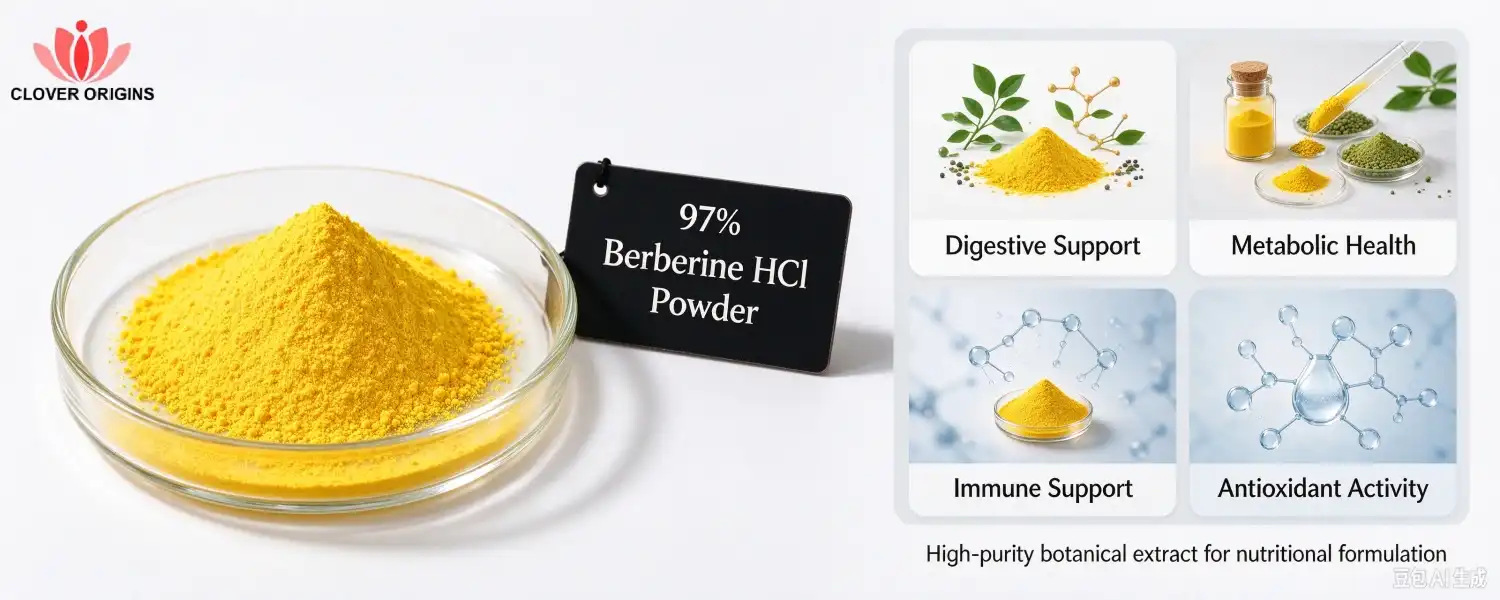
Berberine HCl is a bright yellow solid powder that doesn't smell or taste good at all. Is made up of molecules that are C₂₀H₁₈ClNO₄ and weigh 371.81 g/mol. Some important scientific standards are an HPLC purity test of ≥97.0–98.0%, a LOD loss of ≤12.0%, and an ash level of ≤0.2%. Most of the time, the particles are small enough that 95% of them can get through an 80-mesh screen. This makes it possible to mix things evenly in pill and tablet forms. It doesn't dissolve well in cold water, but it does dissolve well in hot water and ethanol, which lets you use it for many processing methods.
Mechanism of Action
In cells, berberine strongly turns on AMPK, which is also known as a "metabolic master switch." Once this is turned on, it changes how lipids are made, stops the liver from making glucose, and controls how glucose is taken in. In 2008, a large clinical study in the journal Metabolism found that berberine dropped HbA1c by 2.0% in people with type 2 diabetes. This was about the same effect as metformin. Because of these biological connections, it is useful in goods that help with weight loss, heart health, and metabolic health.
Safety and Regulatory Profile
Some people can handle taking 500 mg of Berberine HCl two or three times a day. Most of the time, people report mild stomach pain as a side effect. It has been shown to mix with drugs that are broken down by CYP3A4. Formulation scientists should keep this in mind when they make combination products. It is legal to use in dietary supplements in the U.S. market, and many pharmacopeial monographs, like CP, EP, and USP standards, see it as safe. OEMs who want to sell their goods in more than one place will find it easier to follow the rules.
Key Benefits and Applications of Berberine HCl Powder
More and more information about berberine's health has been gathered over the last twenty years. In 2015, the Journal of Ethnopharmacology published a review of more than 27 randomized controlled trials. The review found that controlling blood sugar, cholesterol, and body weight got a lot better. These results make it clear that there are product opportunities in a number of areas with a lot of growth for berberine hcl powder.
Here are the three primary application scenarios where this ingredient delivers measurable value:
- Metabolic Management Supplements: Berberine HCl is the main ingredient in pills and capsules that are meant to help keep blood sugar levels steady and protect heart health. Because it has a high bulk density, makers can make pills that are only 500 mg each while still making enough money. The Global Wellness Institute said the market for diabetes supplements was worth more than $50 billion a year. This has helped nutrition brands compete in that market.
- Animal Nutrition and Pet Health: The gut microbiome of farm animals and pets is changed by berberine chemicals that are found in animal feed. When heat and water are used to make feed pellets, the powder keeps its shape. That is why it is a good addition for feed companies that want to improve gut health in a natural way that doesn't involve antibiotics.
- Cosmeceutical and Topical Formulations: Berberine can help with acne and keep the skin's protective function by lowering inflammation and killing germs. It is used in cosmetics and skin care products. A lot of thought goes into how well the powder absorbs and how safe it is against oxidation when it is added to water-based serums or emulsions. Usually, this means making exact changes to the pH and adding vitamins as co-excipients.
Each of these applications demands a different specification profile, which is why working with a supplier that offers customizable grades and responsive technical support makes a tangible difference in formulation success.
Comparison and Selection Guide for Berberine Forms
Berberine HCl vs. Other Salt Forms
There are different kinds of berberine that work in different ways. More governing bodies recognize Berberine HCl than berberine sulfate or citrate, which is why it is the most popular form on the market. It is also more stable. While the citrate form of berberine is a little better for GI absorption, it also has a lower concentration of strength. The sulfate form is more difficult to dissolve, which makes it less useful in liquids and emulsions. It is still best and least expensive to use Berberine HCl for business-to-business purposes, such as making pills, tablets, and premix mixes.
Berberine vs. Metformin: Clarifying the Niche
In contrast to the drug metformin, berberine is not the same thing. AMPK activation and lowering blood sugar work in ways that are similar. However, berberine is different because it comes from plants and is controlled as a food supplement, including berberine hcl powder. This is a big difference for OEM brands that want to hook people who like natural products. A side-by-side clinical study that came out in 2008 in the journal Metabolism found the same glucose results. This showed that berberine works, so it doesn't need to be pushed as an alternative to drugs.
Dosage and Formulation Timing
The usual therapeutic dose is between 900 mg and 1,500 mg per day, spread out over several meals to keep the GI tract from getting upset and to help the body absorb the drug better. Phytosomes or liposomes can improve bioavailability even more in the mouth than standard pills can. Because the raw powder tastes awful when mixed with water, it needs to be microencapsulated or mixed with bitterness-masking agents before it can be used in drinks.
Procurement and Sourcing of Berberine HCl Powder for B2B Clients
Sources that you can trust need to offer more than just low prices. When you buy in bulk, the most important things are that the purity stays the same from batch to batch, that the supplier can provide up-to-date, auditable paperwork, and that they follow the rules for heavy metal and pesticide residue. You can't be sure that botanical raw materials you get from the wild won't have poisons on them or different amounts of chemicals. These risks are lower for high-end brands because they get their plant ingredients from controlled farms and use tried-and-true extraction methods.
When purchasing goods, those in charge should make sure that they meet the following standards: ISO 9001, FSSC 22000, HACCP, Kosher, and Halal certifications; HPLC-confirmed purity certificates per batch; third-party testing reports that include heavy metals, microbiological limits, solvent residues, and benzo[a]pyrene levels that meet both EU and U.S. standards; and FDA registration paperwork for entering the U.S. market.
Just as important is how quickly logistics can respond. If a seller has things in stock that can be shipped within one to two business days, it takes a big load off of people who need to quickly develop new products. To stick to your launch schedule, custom specification orders that need to change particle size, purity grades, or package forms should at least have a five- to ten-day production wait time.
Market Insights and Industry Momentum
The need for ingredients that contain berberine has grown very quickly. It's because more people are learning about metabolic health, insulin resistance, and how to naturally control their blood sugar. Google Trends shows that the number of searches for "berberine supplement" has been going up for a few years now. North America and Europe are seeing the most growth. The market for berberine was expected to grow at a rate of over 8% per year until 2030, according to Grand View Research's leaders in the field. This made it even more important for teams working on new products that want to see what the future holds. In the gut-brain axis area and for products that help people live longer, there is more room for brands that get there first.
Conclusion
One plant ingredient that has undergone the most stringent testing is berberine hcl powder, which is available to supplement and nutraceutical businesses. Its AMPK activation method, wide range of uses (from metabolic capsules to cosmeceuticals and animal nutrition), and well-established safety profile make it a good choice for sourcing teams, both in terms of science and business. Choose a recognized provider with full traceability, compliant paperwork, and quick technical help. This is the best way to tell the difference between a successful product launch and an expensive formulation delay.
FAQ
What is the shelf life of berberine HCl powder?
Put the powder in a cool, dry place out of direct sunlight and make sure it stays stable for two to three years. Because it soaks up water, it is very important to keep the temperature low while it is being manufactured and shipped.
Does berberine interact with prescription medications?
The CYP3A4 enzyme is stopped from acting by berberine. This can change how some drugs are broken down, such as cyclosporine and some statins. Scientists who work on formulation and regulatory teams should think about these relationships when they make combination products for clinical groups.
Can berberine HCl be used in gummy or liquid formats?
You can't just add the powder to liquids that are based on water because it is bitter and doesn't mix well with cold water. When these types of transportation go wrong, microencapsulation or phytosome complexation can help with both taste and absorption.
What purity grade is appropriate for dietary supplement manufacturing?
Pureness levels of at least 97% (HPLC) meet the needs for dietary supplements. For pharmaceutical purposes or to show off high-end goods, it is best to use a grade of 98% or higher that fully meets pharmacopeial standards.
Partner with Clover Origins for Premium Berberine HCl Powder
The company Clover Origins has been a leader in plant extracts for more than 25 years. They sell approved berberine hcl powder to companies and brands all over the world, including in the United States. These companies are ISO 9001, FSSC 22000, Kosher, and Halal certified. They make sure that our goods always have the same quality, that we can keep track of each batch, and that they meet EU and U.S. quality standards. We are a trustworthy berberine hcl powder supplier. Our minimum order quantities are open, and we offer free trials and technical help. To get a specification sheet or sample right away, please email info@cloverorigins.com or visit cloveroriginsbio.com.
References
1. Zhang, Y., et al. "Treatment of Type 2 Diabetes and Dyslipidemia with the Natural Plant Alkaloid Berberine." Metabolism, 2008.
2. Dong, H., et al. "Berberine in the Treatment of Type 2 Diabetes Mellitus: A Systemic Review and Meta-Analysis." Evidence-Based Complementary and Alternative Medicine, 2012.
3. Lan, J., et al. "Meta-Analysis of the Effect and Safety of Berberine in the Treatment of Type 2 Diabetes Mellitus, Hyperlipemia and Hypertension." Journal of Ethnopharmacology, 2015.
4. Yin, J., Xing, H., & Ye, J. "Efficacy of Berberine in Patients with Type 2 Diabetes Mellitus." Metabolism, 2008.
5. Och, A., Och, M., & Nowak, R. "Berberine, a Herbal Metabolite in the Metabolic Syndrome." Nutrients, 2022.
6. Grand View Research. "Berberine Market Size, Share & Trends Analysis Report." Grand View Research Industry Report, 2023.
Online Message